
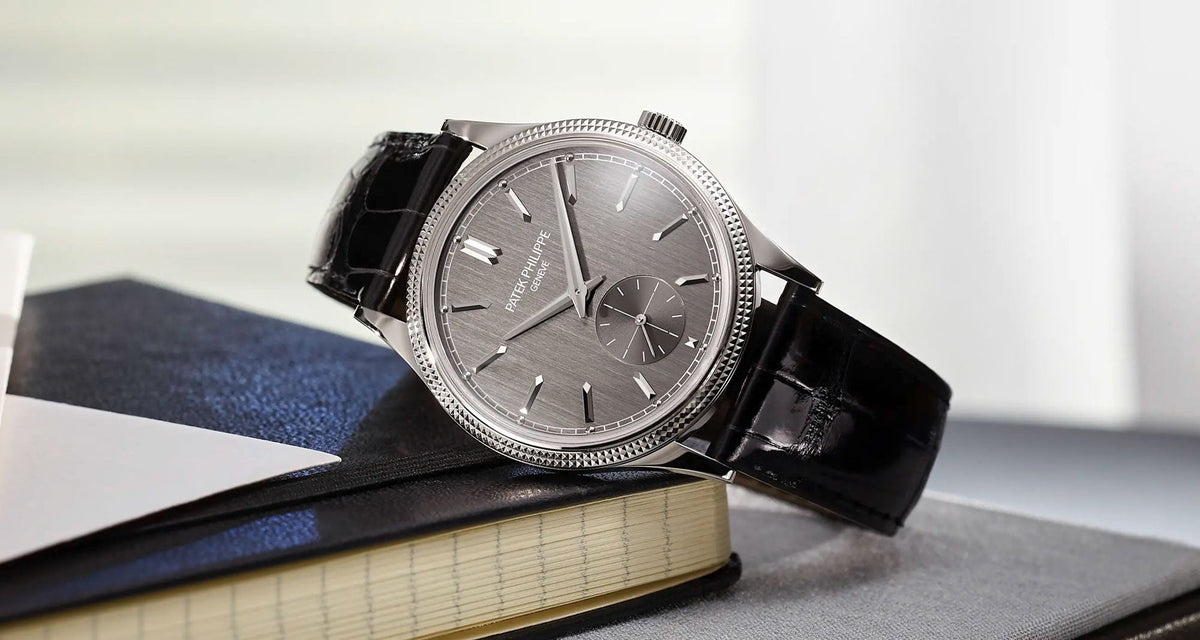

From the Calatrava Cross's registration in 1887 and the landmark Ref. 96 of 1932 to today's interpretations of the classic round watch.
A cross that came first
In 1887, Patek Philippe registered the Calatrava Cross as a trademark, although the emblem had appeared on its watches since the 1870s. Patek Philippe says the reason Adrien Philippe chose the emblem remains uncertain, although it suggests that the lilies may also recall the fleur-de-lis on the coat of arms of Eure-et-Loir, his home region in France.
The emblem remained relatively discreet for decades, becoming more prominent on Patek Philippe watches from the 1960s. Patek Philippe traces the Calatrava collection to Ref. 96, introduced in 1932, and describes its clear round design as a defining part of the line.
Reference 96 in 1932
In 1932, Jean and Charles Stern, owners of Patek Philippe's dial supplier, acquired the company. They appointed watchmaker Jean Pfister to lead it, and movement production was brought in-house. Patek Philippe also began using model reference numbers during this period, with Ref. 96 regarded as its first numbered model. The watch paired a round case and slender bezel with tapered lugs and a restrained, highly legible dial. Its emphasis on clear form reflected the Bauhaus design principles associated with the era.
Its proportions and restrained approach to watch design became a reference point for later Calatrava models.

From Ref. 96 to today
The Clous de Paris, or hobnail, bezel appeared on Calatrava Ref. 96D in 1934. Ref. 3919 made it a signature detail in 1985, paired with Roman numerals and small seconds. Calatrava Ref. 5196 in 2004 returned to Ref. 96's simpler lines with manual winding and small seconds. Calatrava Ref. 6119 updated the hobnail design in a 39 mm case in 2021. The platinum Calatrava Ref. 6196P-001 of 2025 returns to a smooth bezel, manual winding and small seconds. These references show how the two design traditions continue together.
The design of the collection
Over time, the Calatrava has made room for officer's-style casebacks, date displays and other calendar functions, as well as watches that simply show the time. The round case and attention to proportion remain central, even as its dial designs range from traditional to graphic. The Patek Philippe Seal applies to the complete mechanical watch, including its movement, case and external components, as well as standards for finishing, function and precision.
"You never actually own a Patek Philippe. You merely look after it for the next generation."
Three current highlights
The current collection shows how differently the Calatrava's design can be interpreted. These three references illustrate that range.
5227G-015: The vintage expression
White gold, 39 mm

The officer's-style case has a concave bezel, curved and scalloped lugs, and an invisibly hinged dust cover protecting the sapphire caseback. A rose-gilt opaline dial, faceted charcoal-grey 'obus' markers and dauphine hands complement the chocolate-brown alligator strap. Its self-winding calibre 26-330 S C displays the date and sweep seconds, with a stop-seconds function for precise time-setting. The details recall Patek Philippe's earlier round watches.


6007G-001: The contemporary expression
White gold, 40 mm

This 40 mm model brings a more graphic face to the round case. Its ebony-black dial combines a carbon-embossed centre, a snailed inner minute scale, a circular satin-finished hour ring and a sunburst outer minute scale. Yellow details on the minute and sweep-seconds hands, together with the stitching and lining of the black patterned calfskin strap, add a restrained flash of colour. The same self-winding calibre 26-330 S C powers its date display and sweep seconds. The result feels contemporary while retaining the Calatrava's clarity.


7200/50G-001: The slender expression
White gold, 34.6 mm, Ladies' Calatrava

The smallest and slimmest of these three references, this Ladies' Calatrava pairs an officer's-style case and straight lugs with a sand-beige sunburst dial, white-gold Breguet numerals and pear-shaped hands. A matching calfskin strap keeps the palette quietly coherent. Inside, the ultra-thin self-winding calibre 240 measures 2.53 mm and uses a 22-carat gold mini-rotor, contributing to the watch's 7.37 mm case thickness. This reference displays hours and minutes only, an intentionally simple face with a distinctive character of its own.


A continuing design lineage
The 5227G-015, 6007G-001 and 7200/50G-001 each use a round case to very different effect, from a vintage-influenced officer's case to a graphic dial and a slim two-hand design. What connects them to Ref. 96 is the attention paid to proportion, legibility and detail, even as their sizes, movements and personalities differ.

About the author
Thomas Fitzpatrick is Digital Operations Specialist at Berry’s Jewellers and has worked in the Luxury Watch and Jewellery industry since 2019. His writing reflects a particular interest in watchmaking history, exploring Patek Philippe’s heritage and the stories behind its distinctive collections.
Leave a comment
This site is protected by hCaptcha and the hCaptcha Privacy Policy and Terms of Service apply.